Pamela
What kinds of activities do you enjoy most in your daily life?
I really love gardening. I do a lot of stuff on the ground, and because of that I always have to be tilting my neck and twisting and that kind of thing. So, gardening and reading—I’m a big bibliophile.
When did your neck problems first begin?
My neck problems originally started in about 2010. I woke up and I had a really, really bad neck pain. I thought maybe I'd slept wrong. It continued for several days.
What did the early medical evaluations show?
I went to a doctor that's now retired, and he took some X-rays and MRI and said, you know, there’s really nothing there. I just think you slept wrong. But it persisted on and off. I kind of gave it thought, kind of didn't.
When did the pain become serious enough to revisit treatment?
Around 2017, the pain was bad enough that I went to an orthopedic and decided to have them take a look at it. They did some scans and said, okay, you have some very mild deterioration in some of your vertebrae—nothing to worry about, just some PT will take care of it. It hurt too much basically.
What led you to the next step in your treatment?
So I went to an orthopedic surgeon and he recommended that I have an anterior cervical discectomy and fusion—an ACDF—and he showed me why, and I agreed. Unfortunately, that procedure failed for a number of reasons.
What stood out to you about Dr. Truumees when you were researching surgeons?
What attracted me the most to Dr. Truumees when I researched him was he was interested in: How is the patient moving right now? How is the patient going to move if we do the surgery? How is this patient—how should they be able to move afterward? My biggest thing with him was: I need a quality of life.
How were your hobbies and wellbeing affected before seeing him?
I had stopped gardening over a year ago. I could not read for longer than five or ten minutes without pain, which means that I had stopped reading. And what happens is that when you lose the things that are your hobbies and that are therapeutic for you, you get depressed.
What was Dr. Truumees’s approach to your care?
He was interested in “We have to give you back your quality of life.” And that’s what happened.
How do you feel now after surgery?
I have absolutely no pain in my neck. I have more mobility now, more range of motion. I can swivel in ways I could not swivel before. I can pivot. I can tilt. I can rotate. I can see the stars at night, which I had not been able to see for a very long time.
How would you describe your overall experience with Dr. Truumees and his team?
The whole time I have to say that I’m really thankful to him and all of the team that he works with, because they always act like they have the time in the world to talk to me—including Dr. Truumees. And I know he’s a very busy man. He was very, very clear about things and never got annoyed with any of my questions, at least not that I could tell.
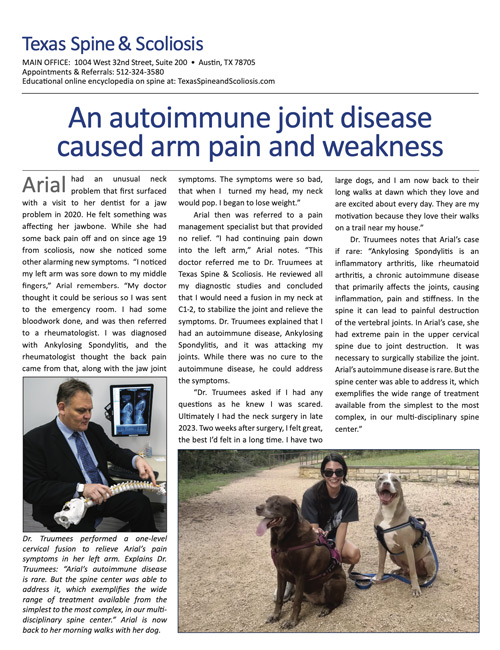
Arial
Arial had an unusual neck problem that first surfaced with a visit to her dentist for a jaw problem in 2020. He felt something was affecting her jawbone. While she had some back pain off and on since age 19 from scoliosis, now she noticed some other alarming new symptoms. “I noticed my left arm was sore down to my middle fingers,” Arial remembers. “My doctor thought it could be serious so I was sent to the emergency room. I had some bloodwork done, and was then referred to a rheumatologist. I was diagnosed with Ankylosing Spondylitis, and the rheumatologist thought the back pain came from that, along with the jaw joint symptoms. The symptoms were so bad, that when I turned my head, my neck would pop. I began to lose weight.”
Arial then was referred to a pain management specialist but that provided no relief. “I had continuing pain down into the left arm,” Arial notes. “This doctor referred me to Dr. Truumees at Texas Spine & Scoliosis. He reviewed all my diagnostic studies and concluded that I would need a fusion in my neck at C1-2, to stabilize the joint and relieve the symptoms. Dr. Truumees explained that I had an autoimmune disease, Ankylosing Spondylitis, and it was attacking my joints. While there was no cure to the autoimmune disease, he could address the symptoms.
“Dr. Truumees asked if I had any questions as he knew I was scared. Ultimately I had the neck surgery in late 2023. Two weeks after surgery, I felt great, the best I’d felt in a long time. I have two large dogs, and I am now back to their long walks at dawn which they love and are excited about every day. They are my motivation because they love their walks on a trail near my house.”
Dr. Truumees notes that Arial’s case if rare: “Ankylosing Spondylitis is an inflammatory arthritis, like rheumatoid arthritis, a chronic autoimmune disease that primarily affects the joints, causing inflammation, pain and stiffness. In the spine it can lead to painful destruction of the vertebral joints. In Arial’s case, she had extreme pain in the upper cervical spine due to joint destruction. It was necessary to surgically stabilize the joint. Arial’s autoimmune disease is rare. But the spine center was able to address it, which exemplifies the wide range of treatment available from the simplest to the most complex, in our multi-disciplinary spine center.”
Kip
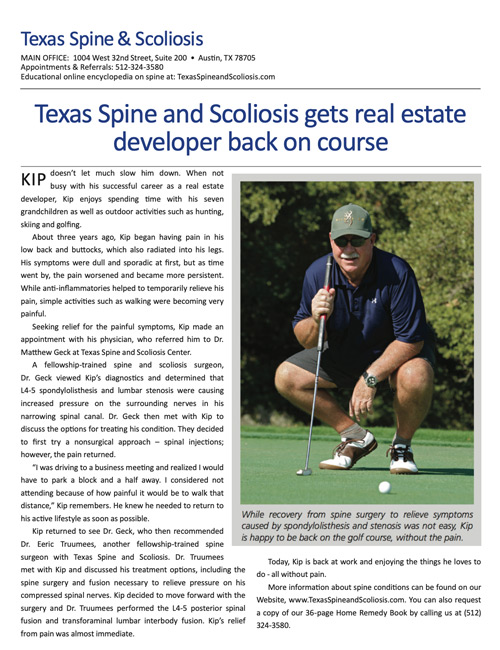
Kip doesn’t let much slow him down. When not busy with his successful career as a real estate developer, Kip enjoys spending time with his seven grandchildren as well as outdoor activities such as hunting, skiing and golfing.
About three years ago, Kip began having pain in his low back and buttocks, which also radiated into his legs. His symptoms were dull and sporadic at first, but as time went by, the pain worsened and became more persistent. While anti-inflammatories helped to temporarily relieve his pain, simple activities such as walking were becoming very painful.
Seeking relief for the painful symptoms, Kip made an appointment with his physician, who referred him to Dr. Matthew Geck at Texas Spine and Scoliosis.
A fellowship-trained spine and scoliosis surgeon, Dr. Geck viewed Kip’s diagnostics and determined that L4-5 spondylolisthesis and lumbar stenosis were causing increased pressure on the surrounding nerves in his narrowing spinal canal. Dr. Geck then met with Kip to discuss the options for treating his condition. They decided to first try a nonsurgical approach – spinal injections; however, the pain returned.
“I was driving to a business meeting and realized I would have to park a block and a half away. I considered not attending because of how painful it would be to walk that distance,” Kip remembers. He knew he needed to return to his active lifestyle as soon as possible.
Kip returned to see Dr. Geck, who then recommended Dr. Eeric Truumees, another fellowship-trained spine surgeon. Dr. Truumees met with Kip and discussed his treatment options, including the spine surgery and fusion necessary to relieve pressure on his compressed spinal nerves. Kip decided to move forward with the surgery and Dr. Truumees performed the L4-5 posterior spinal fusion and transforaminal lumbar interbody fusion. Kip’s relief from pain was almost immediate.
Today, Kip is back at work and enjoying the things he loves to do - all without pain.